Before the birth of the Messiah, the world lived as though it were twilight rather than full night, dim enough to lose its way, yet bright enough to remember that light once existed. Truth had not vanished, but it had been bent, buried, or blurred by time. Many spoke God’s name without truly knowing Him. Power ruled where humility should have, and fear and pride often passed for wisdom. Yet even in that half light, hearts still ached for something more. People sensed that the world was not what it ought to be, and they longed for the day when light would return. Into that waiting world, God did not send an idea or a rule, but light itself. The child born in Bethlehem would not merely speak truth. He would be the truth, shining quietly into the darkness.
Mary was one of those quiet souls who listened for God even when the world was loud. She was young, unknown beyond her village, and had no plans for greatness. When the angel came to her, he said, “Fear not, Mary: for thou hast found favour with God.” He told her she would bring forth a Son, and that His name would be Jesus. Mary did not argue or demand explanations. She asked how such a thing could be, and when she heard that it was the will of God, she answered simply, “Behold the handmaid of the Lord; be it unto me according to thy word.” That trust would carry her farther than she could imagine.
Joseph, the man she was promised to marry, was steady and good, the sort of man who tried to do what was right even when it cost him something. When he learned of Mary’s condition, he was troubled, for he did not yet understand God’s hand in it. But an angel of the Lord appeared to him in a dream and said, “Joseph, thou son of David, fear not to take unto thee Mary thy wife.” He was told that the child was conceived by the power of God, and that this Son would “save his people from their sins.” Joseph listened, and he obeyed. In doing so, he protected Mary and saved her life, choosing faith over fear.
At that time, a command went out from the rulers of the land that everyone must travel to be counted. This was no accident, though it likely seemed like one. Because Joseph was of the house and lineage of David, he and Mary journeyed to Bethlehem. The road was long, and Mary was near the time of her delivery. There were easier moments in history when the Son of God might have come, but this was the moment God chose.
Bethlehem was crowded when they arrived. Joseph and Mary likely stayed among family, but there was no room in the upper room where guests were usually welcomed. Instead, they found shelter in the lower room, where animals were kept. It was not grand, but it was quiet. It was with family. And it was enough.
There, in that humble place, Jesus was born. Mary wrapped Him in swaddling clothes and laid Him in a manger. He did not cry out to announce Himself. He did not arrive as people expected the King of Kings to arrive. Yet this small child was the one through whom all things were made.
That same night, shepherds were keeping watch over their flocks in the fields. They were ordinary men, doing ordinary work, thinking ordinary thoughts. Suddenly, the darkness was pierced by light, and an angel of the Lord came upon them. They were sore afraid, for when heaven draws near, it often startles those who were not expecting it.
The angel said unto them, “Fear not: for, behold, I bring you good tidings of great joy, which shall be to all people.” He told them that “unto you is born this day in the city of David a Saviour, which is Christ the Lord.” They would find Him not in a palace, but “wrapped in swaddling clothes, lying in a manger.”
Then the sky burst alive with angels, a multitude of the heavenly host, praising God and saying, “Glory to God in the highest, and on earth peace, good will toward men.”
When the angels were gone, the shepherds did not debate what they had seen. They said one to another, “Let us now go even unto Bethlehem,” and they went with haste. When they found Mary and Joseph and the child just as they had been told, they made known abroad the saying which was told them concerning this child. And all who heard wondered.
Mary listened to their words and kept them, pondering them in her heart. She did not yet see the whole story, but she knew God was at work.
And so the King of heaven came quietly into His own world, not to condemn it, but to save it.
While the shepherds returned to their fields, glorifying and praising God, heaven was still at work far beyond Bethlehem.
In distant lands to the east lived wise men, students of ancient writings and watchers of the heavens. They were seekers, men who believed that truth leaves marks behind it for those willing to look. When they saw a new star rise in the sky, they knew it was no ordinary sign. Somewhere, the promised King had been born.
They prepared for a long journey, gathering gifts worthy of the One they sought. Gold, fit for a king. Frankincense, used in worship. Myrrh, costly and somber, though its meaning was not yet fully known.
The journey was long, and the star did not shout directions. It guided quietly, asking them to choose faith again and again. When they came to Jerusalem and asked where the King had been born, the city was troubled. King Herod heard and was afraid, for power trembles when true kingship draws near. Though he pretended interest, his heart was dark, and God warned the wise men not to return to him.
At last, the star led them to the child. When they saw Jesus with His mother Mary, they fell down and worshipped Him. They did not kneel because the room was grand or the child impressive in appearance. They knelt because they knew who He was. In that quiet act of worship, wisdom bowed before truth.
But the birth of Jesus was not marked only by stars and angels in the Old World.
Far across the great waters, in the Americas, lived a people who had also been taught to watch and wait. Prophets had spoken plainly, promising that the night would not bring darkness, but that there would be light upon the land as if it were day.
As the sun went down on the appointed night, the faithful waited in fear and hope. Many had mocked them. Some had threatened their lives if the signs did not appear. Everything rested on whether God would keep His word.
Then the night did not fall.
Light remained. The sky held fast. Stars appeared, and a new star shone forth, clear and steady. Fear turned to joy. Doubt gave way to praise. The people fell to their knees, weeping with gratitude, for they knew that the Savior of the world had been born.
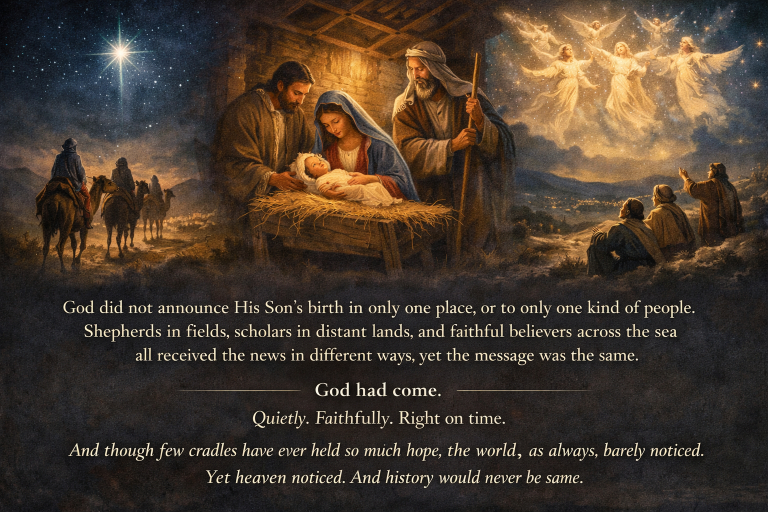
It is worth noticing that God did not announce His Son’s birth in only one place, or to only one kind of people. Shepherds in fields, scholars in distant lands, and faithful believers across the sea all received the news in different ways, yet the message was the same.
God had come.
Quietly. Faithfully. Right on time.
And though few cradles have ever held so much hope, the world, as always, barely noticed.
Yet heaven noticed.
And history would never be the same.